
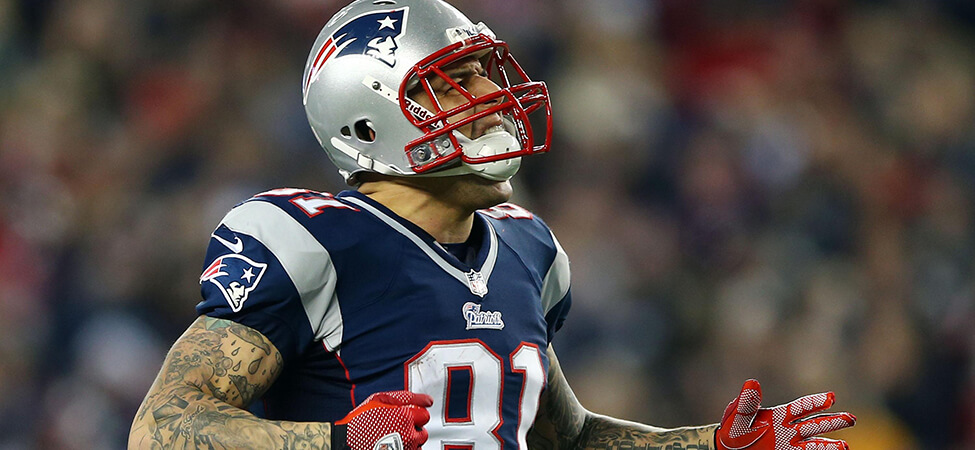
Aaron Hernandez: Promise, Pressure, and a Tragic Collapse
Aaron Hernandez rose through American football incredibly fast, and there was no denying his talent. Blessed with rare athleticism and a relentless competitive edge, he ascended from a standout high school prospect to a national champion and NFL star. The Story of Aaron Hernandez, however, would ultimately become one of the most unsettling in modern sports — not for what he achieved on the field, but for how his life unraveled beyond it.
Early Life and Formative Years (1989–2006)
Born on November 6, 1989, in Bristol, Connecticut, Hernandez grew up in a turbulent household shaped by instability and strict discipline. Football quickly became both an outlet and an identity. At Bristol Central High School, he emerged as an elite tight end, earning All-American recognition and attracting national attention.
In January 2006, when Hernandez was just 16 years old, his father died following complications from surgery. Those close to him later described this period as emotionally destabilizing, a turning point that coincided with his final years of adolescence and growing public scrutiny as a top recruit.
College Success and Early Warning Signs (2007–2009)
Hernandez enrolled early at the University of Florida in 2007, joining a powerhouse program under head coach Urban Meyer. On the field, his impact was immediate. He played a significant role in Florida’s 2008 national championship run, helping solidify the Gators as the dominant team in college football.
Off the field, however, Hernandez drew occasional attention from law enforcement in connection with incidents for which no charges were filed. At the time, these moments were largely overshadowed by his athletic success. After a standout junior season, he declared for the NFL Draft in January 2010.
NFL Breakthrough with New England (2010–2012)
Selected by the New England Patriots in the fourth round of the 2010 NFL Draft, Hernandez quickly outperformed expectations. Paired with Rob Gronkowski, he became part of one of the league’s most dangerous tight end combinations, thriving in a high-powered offense led by Tom Brady.
In August 2012, the Patriots rewarded him with a five-year contract extension reportedly worth $40 million. Later that year, Hernandez welcomed the birth of his daughter, a milestone that appeared to mark stability and personal growth during the peak of his professional career.
Escalating Legal Troubles (2013)
Public scrutiny intensified in early 2013 following a shooting incident involving Alexander Bradley, a longtime associate of Hernandez. The situation later became the subject of civil and criminal proceedings.
On June 17, 2013, Odin Lloyd, a semi-professional football player with personal ties to Hernandez’s family, was found dead near Hernandez’s Massachusetts home. Nine days later, Hernandez was arrested and charged in connection with Lloyd’s killing. The Patriots released him the same day.
Trials and Conviction (2014–2015)
In 2015, Hernandez was found guilty of first-degree murder in the death of Odin Lloyd and sentenced to life in prison without the possibility of parole.
He later stood trial for a separate 2012 double-homicide in Boston involving Daniel de Abreu and Safiro Furtado. In April 2017, a jury acquitted him of those charges, underscoring the legal complexity surrounding the multiple cases tied to his name.
Death and Medical Findings (2017)
Five days after his acquittal, on April 19, 2017, Hernandez was found dead in his prison cell in an apparent suicide. He was 27 years old.
Subsequent examination of his brain revealed advanced Stage 3 chronic traumatic encephalopathy (CTE), a degenerative condition associated in medical research with repeated head trauma. Studies have linked CTE to symptoms such as impaired judgment, emotional instability, and impulse control issues, though its precise role in individual behavior remains the subject of ongoing scientific study.
Aaron Hernandez’s story is one of those that stays with you. It’s about extraordinary talent colliding with personal pain, pressure, and issues that were never fully addressed. He went from being celebrated at the highest level of the sport to becoming a cautionary example of how success can mask deeper struggles rather than fix them. It’s a reminder that achievement and fame don’t protect someone from their inner battles, and sometimes, they make them harder to see.